 Nina
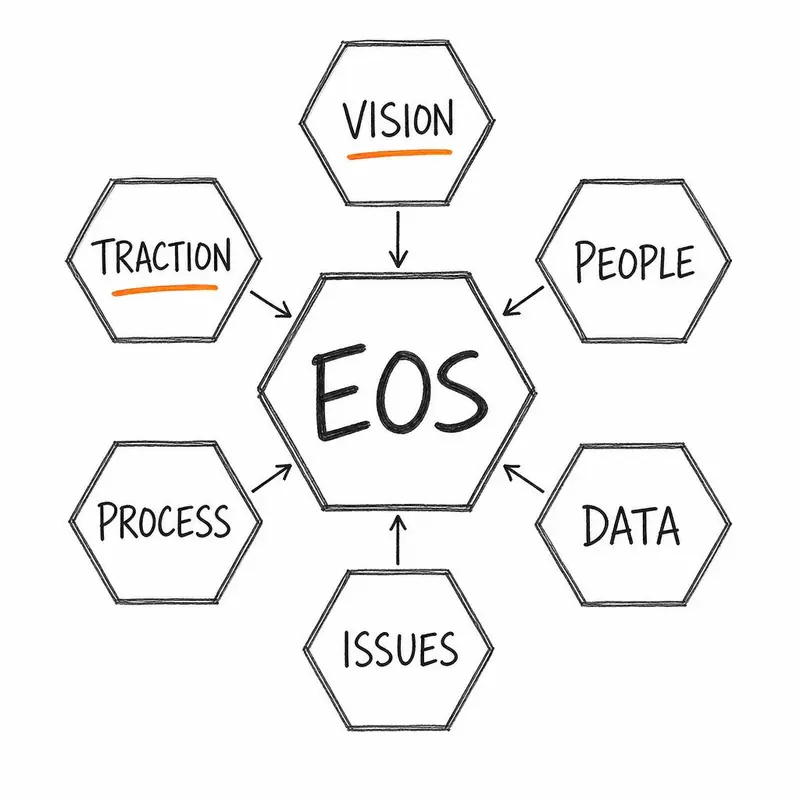
I did not discover EOS because I was looking for an operating system.
I found my way to EOS after years of working inside growing entrepreneurial companies and seeing how hard scaling becomes when there is no real operational foundation holding the business together.
A career built around operational clarity
My career started in luxury hospitality. I studied hospitality management and business administration in Switzerland and worked in five-star hotels helping ensure more than 1,400 employees consistently followed the same standards and SOPs.
That fascinated me.
Not just the systems themselves, but what happens when everyone operates from the same playbook:
- clearer expectations
- stronger execution
- better customer experience
- less chaos
When I moved to Canada, I shifted into hospitality and travel tech and got my first real exposure to the entrepreneurial world.
It was a wild ride.
We experienced acquisitions, buybacks, rapid growth, operational ceilings, and constant change. Like many entrepreneurial companies, we were figuring things out as we went. There was a lot of ambition and momentum, but not always the structure to support it.
Later, I helped grow a boutique advisory firm in the Middle East where I was both client-facing and deeply involved in building the internal operations of the business. Again, I kept seeing the same thing:
The businesses that scaled well had operational clarity. The businesses that struggled had too much living inside the founder's head.
The moment EOS clicked
Then I joined a startup in Vancouver as Chief of Staff. The founders had previously run businesses on EOS, so we brought in an EOS Implementer to help roll it out internally.
That was the moment everything clicked for me.
For the first time, I saw a framework that connected all the operational pieces entrepreneurial businesses struggle with:
- alignment
- accountability
- communication
- priorities
- leadership structure
- execution
I went deep into EOS. I read all the books, spent a huge amount of time with our Implementer, and became the de facto Integrator internally as we rolled EOS out across different teams.
And I saw the impact firsthand.
The leadership team spoke the same language. Priorities became clearer. Issues surfaced faster. Teams understood ownership better. Execution became more consistent.
The business operated differently.
Why we kept coming back to EOS
After leaving that company, I started consulting with entrepreneurial businesses and eventually built my fractional Integrator practice. No matter the company or situation, I kept coming back to EOS as the operational foundation.
Over the years, I explored other frameworks like Scaling Up and Metronomics. There are great ideas within all of them. But EOS consistently stood out because it takes strong business principles and turns them into something entrepreneurial companies can actually operationalize day to day.
Simple scales.
That is one of the reasons we believe in it so strongly at OpsLab.
EOS creates:
- shared language
- visibility
- accountability
- focus
- stronger leadership alignment
- healthier execution rhythms
Most importantly, it helps businesses stop relying on the founder to hold everything together.
Why OpsLab only partners with EOS companies
That is also why OpsLab only partners with companies running on EOS or committed to implementing it properly.
EOS gives us a common language and operational foundation to help leadership teams execute at a higher level. It creates the structure needed for a strong Integrator function to truly hold.
We have seen firsthand what happens when entrepreneurial companies operationalize EOS properly. Teams make better decisions. Leaders gain clarity. Execution improves. Businesses become healthier and more scalable.
Founders do not need more complexity.
They need a framework that helps the business operate with clarity, accountability, and consistency as it grows.
For us, EOS continues to be the best foundation we have found for doing exactly that.