 Shannon
One of the biggest gaps I see in growing organizations is not strategy. It is a shared understanding.
Outside of the leadership team and maybe a handful of others, very few people in a company truly understand where the business is going.
Department heads often do a great job translating direction to their teams. But there is something uniquely powerful about bringing the entire organization together and telling the story together.
That is where town halls come in.
Why Town Halls Are So Important
At their core, town halls create shared clarity.
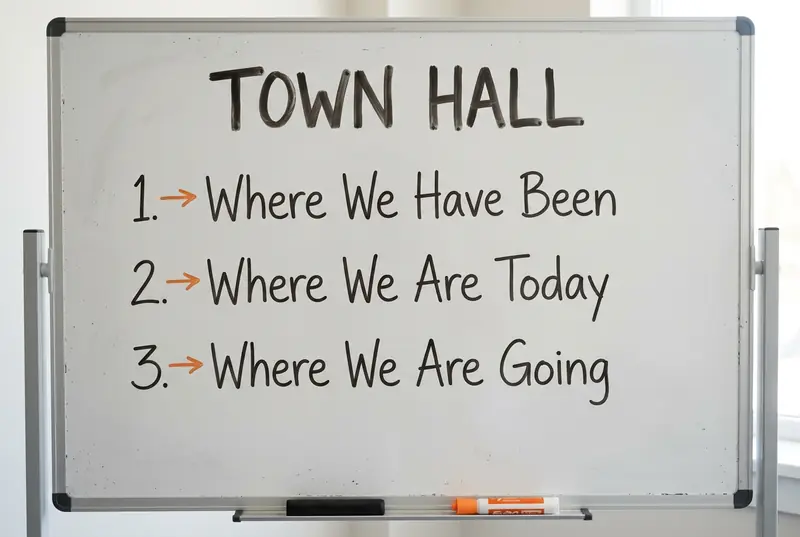
They give every single person in the organization a chance to zoom out from their seat and see the bigger picture. When done well, a great town hall answers three simple but powerful questions:
- 1Where we have been
- 2Where we are today
- 3Where we are going
This sounds simple, but the impact is profound.
Most people spend their days deep in their functional roles. They are executing, delivering, and solving problems. But they rarely get the opportunity to step back and see how all the human energy in the organization is coming together.
A town hall creates that moment.
Clarity is not absorbed passively. It has to be created intentionally.
Town Halls Strengthen Culture
Most importantly, it helps people understand how they fit into the story.
When organizations do not create moments like this, culture can quietly erode. People begin to operate in silos. Departments drift into their own narratives. Individuals create their own interpretations of what is happening.
Town halls reconnect the dots. They remind people:
- We are building something together
- Our work is interconnected
- We are part of something bigger than our individual roles
They also create a powerful opportunity to reinforce core values. Instead of values living on a wall or a slide, town halls let you bring them to life: highlight real examples, celebrate people living the values, and clarify what they actually mean in practice.
Town Halls Tell the Company Story
I often say that businesses are simply groups of humans harnessing energy to build a story.
Like all good stories, there are chapters: the beginning, the messy middle, the breakthrough moments, and the long arc of the future.
Town halls help people understand where they are in that story.
If you are early stage, it helps people see that this is just the beginning and where you are going. If you are navigating challenges, it shows that leadership sees the bumps and is moving forward together. If you are scaling, it reinforces the long term vision.
For EOS companies, this is a natural place to reconnect people to your 10 Year Target or BHAG.
The Energy Shift Is Real
One of the most powerful town halls I was part of recently was with a fully remote organization. Team members were spread across the country. Most interaction happened through screens and Slack messages.
During the town hall, the leadership team shared wins from the past quarter, financial momentum, annual objectives achieved, and new clients and team members.
Something incredible happened. The chat lit up. Clapping emojis. Celebration emojis. Messages of pride. Energy.
Afterward, team members reached out to their managers saying things like: 'I finally see how I fit into the bigger picture' and 'That made me proud to work here.'
None of that would have happened without the town hall.
What a Great Town Hall Looks Like
If you are thinking about introducing town halls, keep it simple and structured. Here is a framework I recommend:
1. Where We Have Been: Look back and share key wins and milestones. Celebrations and shoutouts. Progress against annual goals. Stories that reinforce values.
2. Where We Are: Review the company core values. Honest snapshot of the business. Financial context at the right level. Challenges or realities: share openly about what is working and what is not. Transparency builds trust here.
3. Where We Are Going: Vision and future direction. Upcoming priorities and quarterly company Rocks. Big bets and initiatives. How the team contributes.
4. Reinforce Values and People: Highlight team members. Share stories of impact. Connect work to purpose.
5. Open the Door for Questions: Even if questions come afterward, invite them. Town halls should feel like conversations, not broadcasts.
How Often Should You Run Them?
Quarterly is a great cadence for most organizations. It aligns naturally with quarterly Rocks in EOS, business rhythms, and momentum cycles.
Most importantly, it gives teams regular moments to reconnect with the bigger picture.
Final Thought
If you are building something meaningful, do not assume people automatically see it. Clarity is not absorbed passively. It has to be created intentionally.
Town halls create that clarity. They remind people why they are here, what they are building, who they are building it with, and where the story is going.
When people can see themselves inside the story, something powerful happens. They do not just show up to do a job. They show up to build something that matters.