 Shannon
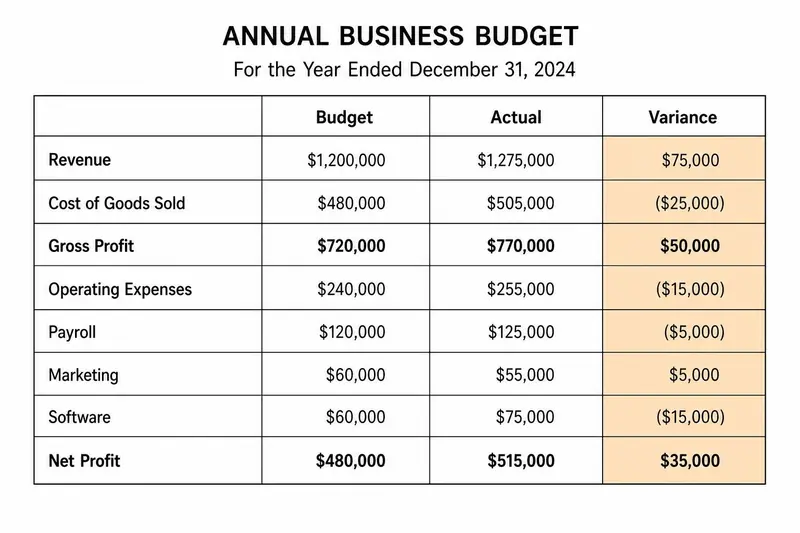
One of the quickest ways to tell whether a business is being led proactively or reactively is to look at its budget.
Not because budgets are exciting. Not because they're perfect.
But because a budget is one of the most powerful tools an Integrator has to turn vision into reality.
Unfortunately, many businesses either don't have a budget at all, or they create one at the beginning of the year and never look at it again.
That's like plotting a destination into your GPS and then driving for twelve months without ever checking if you're still on the right road.
Purpose #1: Turn Vision Into a Financial Plan
Visionaries are constantly thinking about what's next.
- New products
- New locations
- Additional team members
- Marketing initiatives
- Technology investments
- Training and development
All of these things are important. All of them help move the business forward.
But every one of those decisions has a financial impact.
A budget allows us to take all of the qualitative things we want to accomplish and convert them into a financial plan.
If we want to hire two key leaders, what will that cost? If we want to launch a new service line, what investment is required? If we want to attend industry conferences, increase marketing spend, or upgrade our technology, how much revenue must we generate to make those investments while maintaining healthy profitability?
The budget becomes the bridge between the vision and the numbers.
It answers the question: "What has to happen financially for us to make our goals a profitable reality?"
Without a budget, we're guessing. With a budget, we're planning.
Purpose #2: Know Exactly What Questions to Ask
Once the budget is established, it becomes one of the most important management tools in the business.
Because now we can compare what actually happened against what we planned to happen. And that's where the magic happens.
As Integrators, our job isn't simply to look at the numbers. Our job is to investigate the numbers.
Every variance should trigger a question.
Sales are below budget. Why?
What revenue stream is off track? Which location? Which salesperson? Which service line? Is it a volume issue, a pricing issue, a conversion issue, or a pipeline issue?
We should know exactly where the problem exists so we can solve it.
Cost of Goods Sold is higher than expected. Why?
Is it labour? Materials? Subcontractors? Production efficiency? Supplier pricing?
Again, we need to know precisely where the variance is occurring.
Operating expenses are increasing. Where? And why?
Are we overspending on software, marketing, travel, or payroll? If there's a strategic reason behind the investment and it's producing results, great. If not, we stop the spend and trend back toward healthy margins.
The budget gives us something incredibly valuable: a baseline.
Without it, every conversation becomes opinion-based. With it, every conversation becomes fact-based.
The Integrator's Navigation System
I often tell business owners that a budget is not about predicting the future perfectly. It's about creating a map.
When you're sailing a ship, you don't expect to stay perfectly on course every minute of the journey. Wind changes. Weather changes. Currents change.
The purpose of the map isn't perfection. The purpose of the map is knowing when you're off course and correcting quickly.
The same is true in business. A strong Integrator uses the budget to determine:
- 1Are we on course?
- 2How far off course are we?
- 3Why are we off course?
- 4What actions need to be taken to get back on course?
Without a budget, none of those questions can be answered with confidence.
If your Integrator isn't leading the budgeting process, reviewing Budget vs. Actuals, investigating variances, and driving corrective action, they're effectively sailing the ship without a map.
And when you don't know where you are, every decision becomes harder. You drift. Then you drift some more. And before long, you're much farther from your destination than you ever intended to be.
The best Integrators don't use budgets to control the business. They use budgets to guide it.
Because when vision, accountability, and financial discipline come together, extraordinary things become possible.