 Shannon
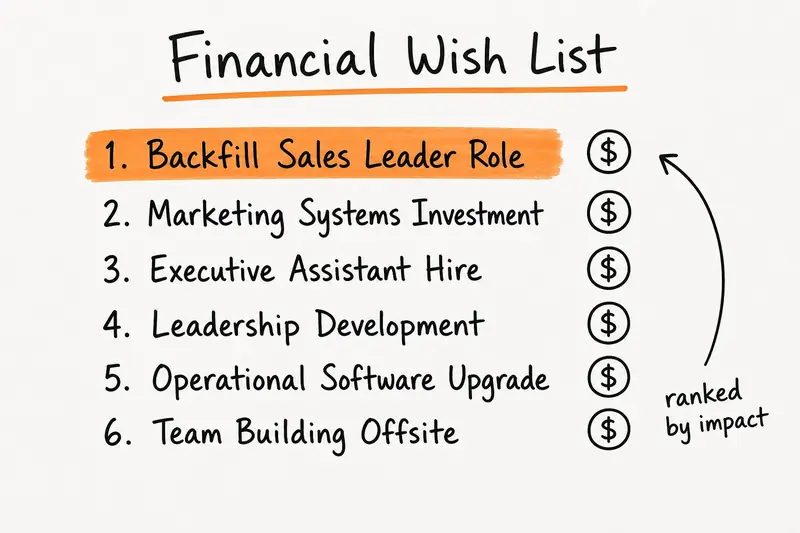
It does not matter the size of the organization. Every business, everywhere, is navigating the same reality:
There are always more ideas, needs, and opportunities than there are resources to fund them.
Your leadership team wants budget for initiatives. Your Visionary has big ideas they want to invest in. You, as the Integrator, likely have your own list of priorities that would move the business forward.
And without a clear process to align all of that?
You end up with scattered spending, reactive decisions, and investments that do not actually move the business closer to its goals.
This is where the financial wish list becomes one of the most practical and powerful tools you can use.
Step One: Get Everything Out of Your Heads and Onto Paper
The first step is simple, but often skipped.
Use your Same Page Meeting with your Visionary to create a complete dump list of every potential investment you are considering.
No filtering. No debating. Just capture it all.
This list might include:
- Hiring an executive assistant
- Backfilling a leadership team seat
- Team building or culture initiatives
- Learning and development programs
- Marketing investments
- Systems or software upgrades
- Operational improvements
This is to create visibility. If it is not visible, it will continue to compete for attention in an unstructured way.
Step Two: Shift from Ideas to Intentional Investment
Once everything is on the table, the role of the Integrator becomes critical.
This is where you move from a list of "things we want" to a plan for how we will allocate finite resources.
Not all investments are created equal.
Some will feel important. Some will feel urgent. But only a few will truly move the business forward in a meaningful way.
Your job is to help the Visionary step back and ask:
- What will have the greatest impact on our financial results?
- What removes the biggest constraint in the business?
- What unlocks capacity at the leadership level?
- What accelerates us toward our V/TO and our financial plan?
Step Three: Rank Order Based on Impact, Not Emotion
This is where many teams get stuck. Because every item on that list can be justified. Every initiative has a reason behind it.
But discipline comes from ranking the sequence of investment.
First. Second. Third.
Not "we will try to do all of this."
But "this is what we are choosing to do first, because it matters most."
And this is where tying everything back to financial outcomes is non-negotiable.
A Practical Example
Let us say your Head of Sales is sitting in both strategic and tactical work.
They are:
- Closing deals
- Managing pipelines
- Supporting the team day-to-day
But they are not:
- Driving long-term sales strategy
- Building scalable systems
- Developing their team at a higher level
You could invest in:
- Team building
- Training programs
- New tools
Or...
You could invest in freeing up that leader's capacity by backfilling part of their role. If that shift allows them to focus on higher-level revenue-driving initiatives, the ROI is clear.
That investment likely moves to the top of the list.
Step Four: Align the Wish List to the Financial Plan
A wish list without financial grounding is just a brainstorming exercise.
The real power comes when you connect it to:
- Your revenue targets
- Your profit goals
- Your budget and cash flow
This is where OpsLab's finance-first lens matters most.
Every investment should answer one question:
How does this help us achieve our financial goals?
If it does not, it does not mean it is a bad idea. It just means it might not be a now priority.
Step Five: Revisit and Refine Quarterly
Your financial wish list is not static.
As the business evolves:
- Priorities shift
- Constraints change
- New opportunities emerge
What was third on the list last quarter might become first this quarter.
Revisiting this list during quarterly planning ensures that your spending stays aligned with what the business actually needs now, not what felt important three months ago.
The Bottom Line
Without a financial wish list, spending decisions become reactive. With one, they become strategic.
This process creates:
- Clarity between the Visionary and Integrator
- Alignment on what matters most
- Discipline in how resources are deployed
- A direct connection between spending and results
And ultimately, it ensures that every dollar invested is working toward building the business you are trying to create.
Because the goal is not to fund everything.
The goal is to fund the right things, in the right order, at the right time.
At OpsLab Integrators, we help visionaries and leadership teams operationalize EOS, strengthen the Integrator function, and build execution rhythms that actually hold.
Whether you need a Fractional Integrator, support developing your internal Integrator, or help improving quarterly execution, we would love to connect.